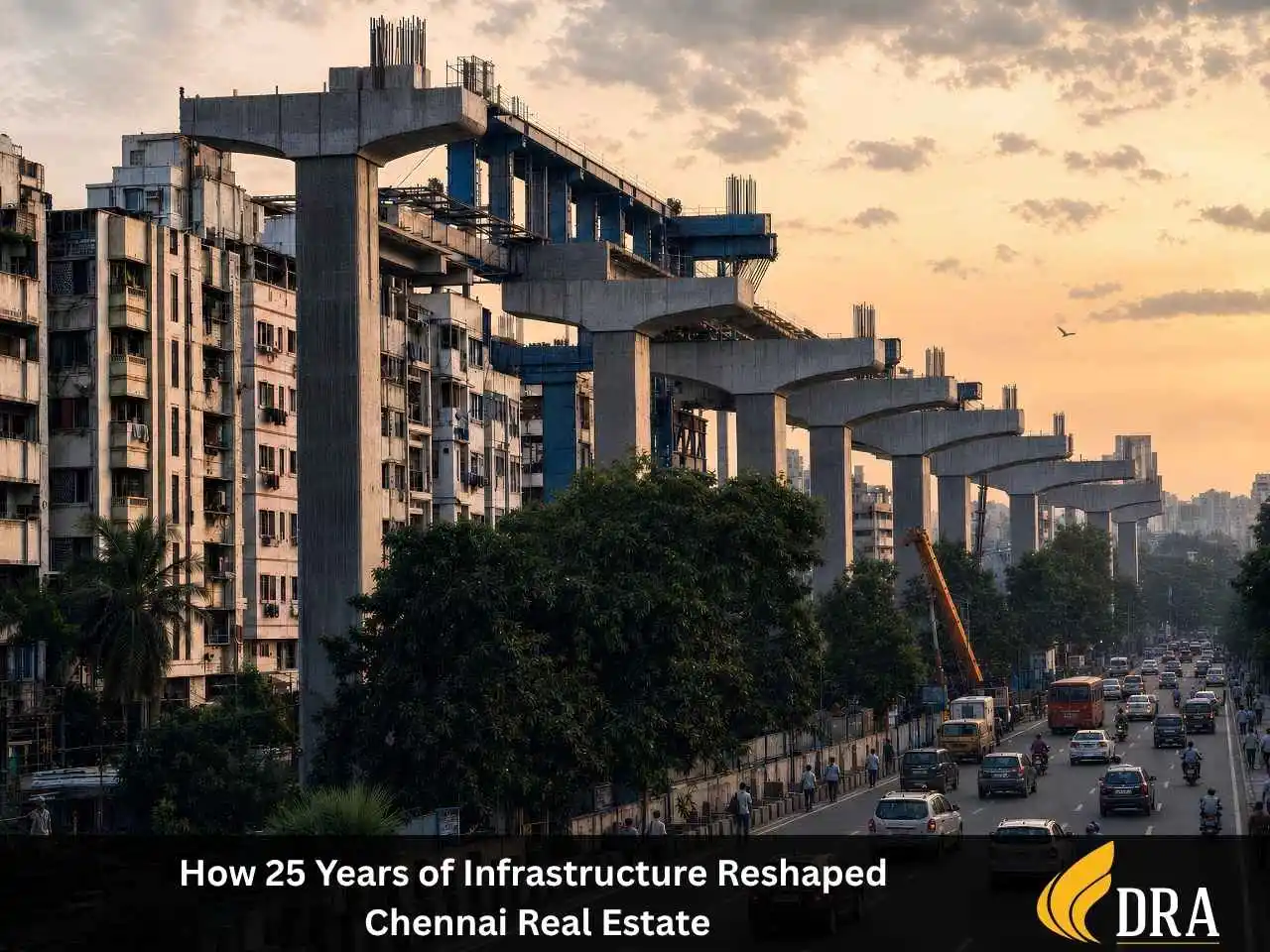
TIDEL Park opened at Taramani on 4 July 2000. The road that carried its workforce, Old Mahabalipuram Road, was not widened into a six-lane carriageway between Madhya Kailash and Siruseri until 29 October 2008. For eight years Chennai's information technology (IT) industry grew along a road that had not yet been built for it.
That gap is the most useful thing to understand about the last 25 years of property values in Chennai. The city's largest transport projects have mostly arrived after the jobs and households they are now credited with attracting, not before. What follows sets out the dates, explains why the order matters to what you pay for a flat and shows what changes now that Chennai Metro Phase II is being built ahead of the settlement pattern for the first time.
In 2000 the area Chennai planned for covered 1,189 sq km. It now covers 5,904 sq km.
The Chennai Metropolitan Area was fixed at 1,189 sq km in 1974 and expanded to 5,904 sq km in 2022, and the Chennai Metropolitan Development Authority still lists that as the current extent. Five districts sit inside it: Chennai, Kancheepuram, Chengalpattu, Tiruvallur and Ranipet.
The plan governing most of the years in between was notified late. Tamil Nadu approved and gazetted the Second Master Plan for the Chennai Metropolitan Area on 2 September 2008, under G.O.Ms. No. 190 H&UD, with a horizon year of 2026. It worked from the 2001 census figure of 7.04 million people in the metropolitan area and projected roughly 12.5 million by 2026. Chennai spent the first eight years of this period growing under a plan that was still being written.
Each milestone below carries the date on which the responsible authority commissioned, sanctioned or opened it.
| Date | Milestone | Status reached |
|---|---|---|
| 4 July 2000 | TIDEL Park opens at Taramani, 1.28 million sq ft, developed by TIDCO and ELCOT | Operational |
| 26 January 2004 | MRTS services reach Thiruvanmiyur | Operational |
| 19 November 2007 | MRTS reaches Velachery, completing the Thirumylai to Velachery section | Operational |
| 2 September 2008 | Second Master Plan for the Chennai Metropolitan Area notified | Approved |
| 29 October 2008 | Six-lane main carriageway of Rajiv Gandhi Salai, formerly OMR, opens to the public | Operational |
| 8 October 2009 | Outer Ring Road receives administrative approval | Approved |
| 28 August 2014 | Mannivakkam to Nemilichery, 27.50 km of ORR Phase I, opens to traffic | Operational |
| 29 June 2015 | First metro stretch, Alandur to Koyambedu, opens | Operational |
| 10 February 2019 | Metro Phase I completed with the AG-DMS to Washermenpet section | Operational |
| 2022 | Chennai Metropolitan Area expanded to 5,904 sq km | Notified |
| 1 February 2024 | Kalaignar Centenary Bus Terminus at Kilambakkam becomes fully operational | Operational |
| October 2024 | Union Cabinet approves Metro Phase II as a central sector project | Approved |
| 14 March 2026 | MRTS services extended from Velachery to St. Thomas Mount | Operational |
Every road and rail project in that list that has opened did so after the employment it now serves was already in place. TIDEL Park and the SIPCOT park at Siruseri pulled workers towards the southern suburbs first, along Rajiv Gandhi Salai and, closer to the coast, the East Coast Road. Road capacity followed in 2008. Ring road capacity followed in 2014. The metro reached Koyambedu in 2015 and Washermenpet in 2019. The bus terminus that serves the GST Road belt around Urapakkam and Guduvanchery became fully operational only in February 2024.
Chennai's expansion between 2000 and 2015 was mostly a road story, and the dates show how late the roads ran.
Rajiv Gandhi Salai covers 45 km from Madhya Kailash junction to the East Coast Road near Mamallapuram, but only Phase I, the 20.1 km as far as Siruseri, was rebuilt in the period that matters here. Its six-lane main carriageway opened on 29 October 2008 and tolling began on 15 December 2008, both under a design, build, finance, operate and transfer contract held by IT Expressway Ltd. Phase II, the 25 km from Siruseri to Mamallapuram with bypasses at Kelambakkam and Tiruporur, is still awaiting administrative sanction.
That same project built the 2.1 km ECR Link Road joining Rajiv Gandhi Salai at Sholinganallur to the East Coast Road at Kudumiyandithoppu, which gave the coastal stretch a direct connection to the IT corridor.
Progress on the Outer Ring Road was slower. CMDA records administrative approval on 8 October 2009 for a 62 km route from Vandalur on NH45 to Minjur on the TPP Road. TNRDC puts Phase I at 29.65 km from Vandalur to Nemilichery at a cost of Rs 1,081.40 crore, of which the 27.50 km from Mannivakkam to Nemilichery opened to traffic on 28 August 2014. The foundation stone for Phase II, 30.50 km on to Minjur, was laid the same day and that phase is still in progress.
On the GST Road corridor the capacity came later still. The Kalaignar Centenary Bus Terminus at Kilambakkam, built across 88.52 acres at a cost of Rs 394 crore to take pressure off Koyambedu, had its foundation stone laid on 22 February 2019, was inaugurated on 30 December 2023 and became fully operational on 1 February 2024.
A road or a rail line does not by itself make a neighbourhood somewhere people want to live. The Chennai record points to a longer sequence: employment lands first, housing follows the employment and the retail, schools and healthcare that make a place liveable arrive after the housing is already there.
Two dated cases show the shape of it. TIDEL Park opened at Taramani on 4 July 2000, eight years before the carriageway that serves it. Velachery is the clearer one. The MRTS reached it on 19 November 2007, and Phoenix Marketcity, a million square feet of retail, opened there in January 2013, five years after the trains.
That ordering matters to a buyer more than it looks. Where the steps can be dated, the gap between a corridor opening and the everyday amenities filling in behind it has run to several years, which is time a household actually lives through. A location that has the road and the jobs but not yet the rest is not the same purchase as one where the sequence has finished, even when the two sit on the same corridor at similar rates.
When infrastructure follows people, a buyer pays for something that already exists. Velachery had a working residential market before the MRTS reached it in 2007. Sholinganallur and Perungudi had offices and residents before the six-lane carriageway opened in 2008. In that pattern the risk sits with the price, not with the delivery. You could see the demand, count the buildings, then argue about whether the asking rate was fair.
When infrastructure leads people, the risk moves. A buyer near a Phase II alignment today is not paying for a corridor that exists. They are paying for one that has been sanctioned, funded and started, and the worth of the purchase depends on the project finishing. That is a different question, and it has a different answer for every stretch.
No published index tracks Chennai housing prices back to 2000. The Reserve Bank's House Price Index starts from a 2010-11 base and has since been rebased to 2022-23, and the National Housing Bank's RESIDEX series began on a 2012-13 base before moving to 2017-18. Anyone quoting a precise 25-year appreciation figure for a Chennai locality is estimating, not citing.
That covers most of the numbers buyers actually see. Quoted OMR property rates, Porur property prices and Sholinganallur figures come from listing platforms and broker averages. No official index publishes Chennai at that level of detail.
What the official series do support is narrower and more useful.
On its 2012-13 base, NHB's index for Chennai moved from 100 to 133 by the quarter ending March 2017, which the bank reported as a 33 per cent rise in housing prices over that period. For the quarter ending December 2025, NHB put Chennai's annual increase at 8.2 per cent against 5.0 per cent across its 50-city composite. The Reserve Bank's index had shown a similar standing earlier, with Chennai at 8.4 per cent year on year in the third quarter of 2023-24, the highest of the ten cities it covered at the time. Knight Frank's figures for the first half of 2026 put the citywide average at Rs 7,555 per sq ft, up 5 per cent.
These come from different indices on different bases and cannot be chained into a single 25-year number. What they agree on is the shape: Chennai has climbed steadily, without the spikes, and in recent quarters has run ahead of the national picture. The absence of spikes is the part worth sitting with, because it sits awkwardly against the way a metro premium is normally sold. If no jump shows up around individual openings, then whatever a corridor is worth has largely been worked into the asking rate well before the first train runs, and the seller has already collected the gain the buyer is being asked to wait for. Buying beside a Phase II stretch today is closer to paying for that appreciation upfront and then carrying the construction years yourself — on Chennai's own record, anywhere from about five years on the first Outer Ring Road stretch to eighteen on the MRTS extension to St. Thomas Mount.
Chennai's delivery record is uneven, and one short piece of rail shows the range better than any average would. Work on the MRTS extension from Velachery to St. Thomas Mount began in April 2008 with an estimated completion of March 2019, according to CMDA. Southern Railway's Chennai division began services on it on 14 March 2026, roughly 18 years after work started.
The Outer Ring Road took a similar shape. Administrative approval came on 8 October 2009. The 27.50 km stretch from Mannivakkam to Nemilichery opened on 28 August 2014, the same day the foundation stone was laid for the second phase running from Nemilichery to Minjur. TNRDC records the first phase concessionaire as having completed 96 per cent of the works.
Metro Phase II is running the same course now. By late July 2026 the 14.6 km stretch from Poonamallee Bypass to Vadapalani had received its safety clearances, but six stations were still unfinished and passenger operations had not begun. For anyone weighing a purchase along the metro extension towards Poonamallee and Parandur, that gap between cleared and running is the thing to watch.
Phase II's largest change in the last two years was a financing decision.
On 5 October 2024 the Press Information Bureau announced that the Union Cabinet had approved the project as a central sector scheme, with the central government financing close to 65 per cent of the estimated Rs 63,246 crore cost through Rs 33,593 crore in loans and Rs 7,425 crore in equity and subordinate debt. Under the earlier state sector model Tamil Nadu carried about 90 per cent. External loans from JICA, the Asian Development Bank, the Asian Infrastructure Investment Bank and the New Development Bank are being restructured to flow through the centre.
That is a delivery signal, not a price forecast, and the two get mixed up constantly. Funding committed nationally is less exposed to a single state budget cycle, which is a reason to take the timeline more seriously, not a reason to assume a number. CMRL's own project description sets out what the money buys: a 118.9 km network of three corridors and 128 stations, targeted for the end of 2028. The way metro funding decisions reach the southern Chennai market follows the same logic.
Knight Frank's India Real Estate report for the first half of 2026 puts Chennai residential sales at 9,198 units, up 3 per cent on the same period a year earlier, alongside 9,588 new launches. Unsold inventory rose 13 per cent to 19,722 units, which at the current rate of sales is about 4.4 quarters of stock.
Where those units are being launched and sold is the part that connects back to the last 25 years.
| Sub-market | Share of new launches, H1 2026 | Share of sales, H1 2026 |
|---|---|---|
| South Chennai | 63% | 57% |
| West Chennai | 21% | 28% |
| North Chennai | 7% | 7% |
Shares are for the three sub-markets reported; the balance is not broken out in the source.
South Chennai, the belt that built out after TIDEL Park and Siruseri, still takes 63 per cent of launches and 57 per cent of sales. West Chennai takes 21 per cent of launches but 28 per cent of sales, the widest gap of the three reported, and North Chennai holds 7 per cent of each. That West Chennai gap does not work in a buyer's favour the way it reads. When sales run ahead of launches the stock a buyer can actually choose between is thinner, and a thin market is where a builder holds his rate and a buyer finds there is nothing much to walk away to. South Chennai is the opposite case, more inventory chasing the same buyer, which is usually where a negotiation has room in it - the corridor that looks like it is being found first is often the one where you end up paying nearest to the asking price.
Now set that against the Phase II map. Two of the three corridors, Madhavaram to SIPCOT and Madhavaram to Sholinganallur, terminate at Madhavaram in the north, which is also where the tech city plan could reshape property around Madhavaram. West Chennai is where Corridor 4 sits closest to opening, through Porur and Valasaravakkam. Read together, these shares suggest the settlement pattern has not yet moved to where the network is heading and that West Chennai is the first place it is starting to. That reading interprets launch and sales shares. It is not a measured effect of the metro, and shares can shift for reasons that have nothing to do with rail. It does change the question a buyer choosing between Valasaravakkam and Porur is really asking.
CMDA puts the design capacity of the MRTS section between Thirumylai and Velachery at 4.25 lakh trips a day. A figure like that measures what the tracks can carry, not what commuters actually use. The distance between the two is mostly a question of how easy a station is to reach on foot.
CMRL appears to be working on that distance before it turns into a complaint. Among its published tenders is a consultancy assignment for a detailed project report on multi-modal integration within a 500 metre radius of 41 Phase I stations, published on 12 August 2026. Commissioning that study for stations already in service, and not only for the ones still being built, points to access being treated as unfinished business.
For a buyer the practical version of this is narrow. The question is not whether a corridor passes near a locality. It is whether the walk from the flat to the station entrance is one a person will actually make twice a day in May.
Four words do most of the work in any infrastructure claim, and they are not interchangeable.
A claim that the metro is coming can describe any of the four. Before it changes what you are willing to pay, establish which stretch is being described, which authority sanctioned it, where the money comes from and what the status was on a stated date. The same discipline applies to a plot, where the check is whether the layout carries CMDA approval inside the metropolitan area or DTCP approval outside it. Much of what separates real movement from noise looks like the signs a Chennai neighbourhood is growing without the price hype.
The Third Master Plan, which will replace the 2008 plan, has not been published, so what the CMDA's third master plan could mean for growth remains an open question. Zoning and permitted floor space along the corridors now under construction are still being settled.
Two events will tell buyers more than any forecast will. The first is whenever the Poonamallee Bypass to Vadapalani stretch actually opens, because it will be the first Phase II section to move from a drawing to a commute, and West Chennai's absorption is already running ahead of its launches. The second is the publication of the Third Master Plan, which will set what can be built along the corridors and at what density.
So what did 25 years of infrastructure do to Chennai real estate? The sourceable answer is narrower than the usual one. It moved where the city could realistically put jobs and housing, opening the southern and western belts that now carry most of its launches and sales, and the official indices record a steady climb, with no visible jumps around individual openings.
For 25 years Chennai's buyers could watch demand arrive and wait for the infrastructure to catch up. On the Phase II corridors that order is reversed. The useful question is no longer how much a station will add. It is whether the stretch you are buying beside has been sanctioned, funded and physically started, and what Chennai's own record says about how long that has taken here.
Does a metro line automatically raise property prices in Chennai?
No. A line changes what a location is worth only if it opens, and only if people can reach the station on foot without much trouble. CMDA rates the MRTS section between Thirumylai and Velachery at a design capacity of 4.25 lakh trips a day, which measures what the tracks can carry, not what commuters actually use. CMRL has since commissioned a study on multi-modal integration around 41 of its Phase I stations, which suggests station access is still being worked on.
How long do infrastructure projects take in Chennai?
The range matters more than an average. Work on the MRTS extension from Velachery to St. Thomas Mount started in April 2008 with a stated completion of March 2019, and services began on 14 March 2026. The six-lane carriageway on Rajiv Gandhi Salai opened to the public in October 2008. CMRL targets the end of 2028 for Metro Phase II.
Is any part of Chennai Metro Phase II open?
No. As of early September 2026 no Phase II stretch is carrying passengers. The 14.6 km section from Poonamallee Bypass to Vadapalani had cleared its safety approvals by late July 2026, with six stations still unfinished and no inauguration date announced.
Which parts of Chennai are selling most at the moment?
South Chennai. Knight Frank's figures for the first half of 2026 give South Chennai 63 per cent of new launches and 57 per cent of sales. West Chennai takes 21 per cent of launches and 28 per cent of sales. North Chennai holds 7 per cent of each. West Chennai has the widest gap of the three sub-markets reported, with its share of sales running higher than its share of launches.


 Link Copied!