
You've finally saved ₹15, ₹20, or even ₹25 lakhs for your home purchase. Now comes a decision that can quietly affect your finances for years: how much of that money should actually go into the down payment?
Whether you're looking at flats in Chennai for the first time or upgrading to a larger home, most buyers instinctively lean toward putting in as much as possible, reducing the loan, reducing the EMI, get it done. That thinking isn't wrong. But it's incomplete, and acting on it without the full picture is one of the most common financial missteps homebuyers make.
A larger home down payment does reduce what you owe and saves on interest. But it also means significantly less money in your hands during one of the most financially demanding phases of your life, particularly in a city where registration charges, interior costs, and move-in expenses can add up faster than most buyers expect. So the real question isn't just "how much can I put in?" It's "how much should I put in, given everything else?" That's what this article is about.
When you buy a home, you pay a portion upfront and borrow the rest as a home loan. The larger your upfront payment, the smaller your loan — and a smaller loan means a lower monthly EMI, less total interest paid over the loan tenure, and a faster path to
being debt-free.
Here's a straightforward illustration:
Home Price: ₹80 Lakhs
| Down Payment | Percentage | Loan Amount |
|---|---|---|
| ₹16 Lakhs | 20% | ₹64 Lakhs |
| ₹24 Lakhs | 30% | ₹56 Lakhs |
To make the difference tangible, here's what those numbers actually look like on a monthly basis:
Home Price: ₹80 Lakhs | Interest Rate: 8.5% | Tenure: 20 Years
| Loan Details | 20% Down Payment | 30% Down Payment |
|---|---|---|
| Down Payment Amount | ₹16 Lakhs | ₹24 Lakhs |
| Loan Amount | ₹64 Lakhs | ₹56 Lakhs |
| Monthly EMI | ₹55,647 | ₹48,690 |
| Total Interest Paid | ₹69.55 Lakhs | ₹60.86 Lakhs |
| Interest Saved | - | ₹8.69 Lakhs |
Note: Illustrative calculation based on a ₹80 lakh property, 8.5% annual interest, 20-year tenure, and standard EMI assumptions; actual lender rates and loan terms will vary.
The ₹8 lakh difference in the down payment saves approximately ₹6,957 per month in EMI and nearly ₹8.69 lakhs in total interest over 20 years. Those are meaningful numbers, and they explain why a larger down payment for a home purchase is genuinely attractive. What they don't show, however, is what that ₹8 lakhs costs you in liquidity and what that can mean in practice.
There are sound reasons why most buyers lean toward putting in
more upfront.
Lower Monthly EMI:
A smaller loan translates directly into a lighter monthly commitment. For buyers managing household expenses, that headroom matters.
Reduced Interest Outgo Over Time:
Home loans run for 15 to 20 years. Even a modest reduction in the loan principal can result in a meaningful difference in the total interest paid over that period.
Shorter Loan Tenure:
A smaller loan can be closed earlier, giving buyers the freedom of being debt-free ahead of schedule.
Financial Confidence:
There is a genuine sense of security that comes with knowing your outstanding loan is smaller. For many buyers, that peace of mind is worth a great deal.
These are all legitimate considerations. The case for a larger home loan down payment is real.
What's often missing from this conversation, however, is the other side of the equation.
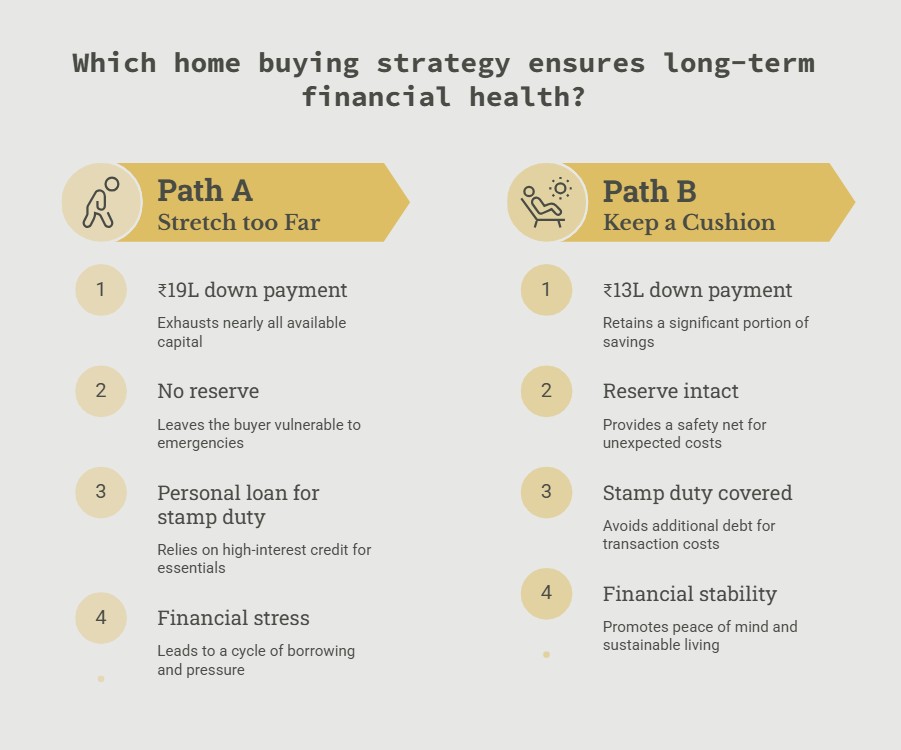
Consider a situation many buyers find themselves in. A buyer has ₹20 lakhs in savings and, determined to keep the loan as small as possible, commits ₹19 lakhs toward the purchase, leaving very little in reserve. The EMI is comfortable, the loan amount is low, and on paper it looks like a disciplined decision.
Then reality sets in. Stamp duty and registration, which weren't fully accounted for, require an additional ₹4 to 5 lakhs, and a personal loan is taken to cover it. Interiors are either delayed or funded through credit at interest rates significantly higher than the home loan. An unexpected family expense arises a few months later, and there is no financial buffer to absorb it. The loan is small, but the overall financial pressure is high. The decision that appeared optimal at the time of purchase creates strain for months afterward. This is not an uncommon outcome, it is the result of optimising for one number without accounting for the full
financial picture.
Statutory and Legal Costs
Setup and Interior Costs
Transition Costs
For a property priced between ₹70 and ₹90 lakhs in Tamil Nadu, these costs can cumulatively range from ₹8 to ₹15 lakhs or more depending on the buyer's choices and the finishing level of the property. Many buyers plan carefully for the home itself. Far fewer plan adequately for what the first six months of ownership actually cost. For a detailed breakdown, read our full guide on the hidden costs of buying
a home.
Now consider a different approach.
The same buyer, with the same ₹20 lakhs, chooses to put in ₹12 to 13 lakhs as the down payment. The remaining amount is kept aside, partly for stamp duty and registration, partly for interiors, and partly as a
financial reserve.
The loan amount is higher. The EMI is slightly more than it would have been in the first scenario, perhaps ₹4,000 to ₹5,000 more per month.
But the buyer moves in without borrowing at high interest rates. Interiors are completed without stress. When an unexpected expense arises, it is handled without a crisis. The slightly higher EMI is a predictable, manageable cost. The absence of financial pressure
is invaluable.
Over the course of a year, the difference in total outgo between the two approaches may be smaller than it first appears, particularly when the cost of personal loans and credit usage in the first scenario is
factored in.
To know more about avoiding this trap, read our guide on how to avoid defaulting on your home loan EMI.
| Particulars | Larger Down Payment | Balanced Approach |
|---|---|---|
| Loan Amount | Lower | Slightly Higher |
| Monthly EMI | Lower | Slightly Higher |
| Emergency Readiness | Limited | Strong |
| Funds for Interiors | May fall short | Available |
| Post-Purchase Flexibility | Constrained | Healthy |
| Overall Financial Stress | Higher risk | Lower risk |
Neither column is universally correct. Your circumstances determine which approach serves you better.
If all or most of these apply to you, a larger home loan down payment is the right call.
The calculus shifts considerably in these circumstances:
Given the costs that follow a property purchase in Chennai, from stamp duty and registration to interiors and maintenance deposits, preserving liquidity in these situations is often the more prudent call. Choosing a slightly higher loan is not a sign of financial weakness. It is frequently the more considered decision.
If you are navigating this for the first time, our guide on what first-time home buyers must know covers the full picture of what to expect and
plan for.
There is no single correct number. But there is a clear principle.
The goal is not to make the largest possible down payment.
The goal is to buy a home well and sustain that stability for years to come.
A home is a long-term commitment. Over a 15 to 20 year loan tenure, your income will grow, your circumstances will evolve, and your financial capacity will shift. Entering homeownership with a manageable EMI, a reasonable reserve, and genuine financial flexibility puts you in a far stronger position than entering with a minimised loan and no cushion.
The buyers who thrive after a property purchase are not always those who borrowed the least. They are the ones who planned the most completely, accounting for the loan, the costs around it, and the life that continues after they move in.
The type of property you buy also plays a role here. Projects with transparent pricing, well-defined payment schedules, and ready infrastructure make it significantly easier to plan accurately. When you know exactly what you're paying, when, and for what, budgeting your down payment becomes a more confident decision rather than an anxious one. That predictability is part of what distinguishes a
well-structured development from one that leaves buyers with financial surprises after possession.
Before finalising your down payment amount, work through these questions honestly:
If two or more of these give you pause, it is worth revisiting how your savings are allocated before proceeding. You may also find it useful to improve your credit score before applying for a home loan, a stronger credit profile often means better loan terms and more flexibility in structuring your down payment.
A bigger down payment can reduce your EMI and save you money on interest. But that doesn't automatically make it the best choice.
The right down payment is one that lowers your loan without leaving you financially stretched after the purchase. Registration charges, interiors, moving costs, and unexpected expenses all require cash, often sooner than buyers expect.
Rather than aiming for the smallest possible loan, aim for the right balance between affordability and financial flexibility. A home should give you peace of mind, not drain every rupee you've saved. That's why the smartest homebuyers don't just plan for the purchase, they plan for everything that comes after it.
At DRA Homes, we believe confident homebuying starts with complete financial clarity. Understanding the full cost of ownership, not just the purchase price, helps buyers make decisions they can comfortably live with for years
to come.


 Link Copied!