
Anyone living in Chennai knows how much daily travel shapes our housing decisions. Whether it’s choosing a rental close to work or shortlisting a flat for long-term living, the first thought is always the same: “How long will the commute take?”
This is exactly why Chennai’s upcoming transport upgrades matter.
The city isn’t improving just one corridor, it’s working toward a more connected system that could gradually change where families prefer to live.
In the next few years, Chennai will see a mix of upgrades across its transport network. Instead of scattered improvements, the city is building stronger links between suburbs, business districts, and residential pockets.
The key developments include:
These changes won’t happen overnight, but they will significantly improve how people move across the city. As these upgrades take shape, buyers exploring well-connected flats for sale in Chennai will find more choices across budgets and locations.
The OMR stretch, for instance, is already seeing a shift thanks to new residential developments in OMR.
Most families want a home that fits comfortably into their routine. A shorter commute means smoother mornings, more personal time, and a better overall living experience.
This is why well-connected localities almost always receive higher interest. As Chennai’s network expands, several suburbs that once felt “too far” may soon become far more practical. When that happens, three things typically follow:
Connectivity is often the quiet force behind rising property value.
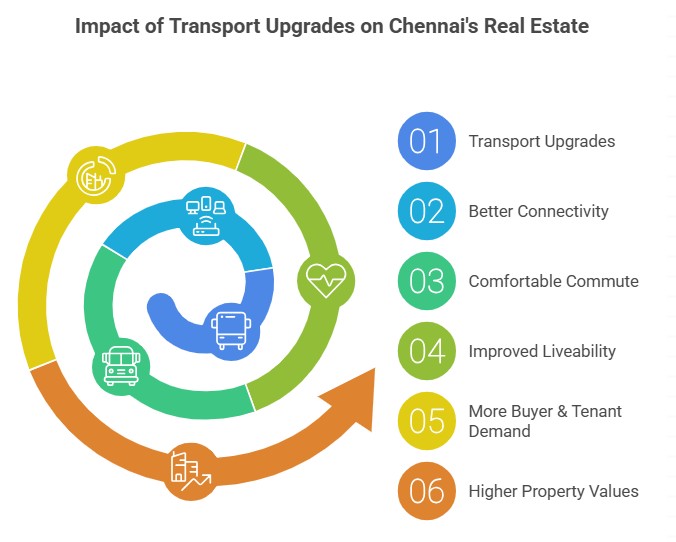
A visual showing how Chennai’s transport upgrades improve connectivity, boost liveability, and strengthen long-term real estate value.
Globally, people prefer homes where essential travel stays within 30–45 minutes. Chennai is moving toward this same pattern.
With new routes planned toward areas such as:
…these locations may soon fall under the “easy commute” category.
For example, Avadi’s growing first-home market is already benefiting from better connectivity and affordability, a key combination for first-time buyers.
When travel feels lighter, a neighbourhood’s liveability improves instantly.
Metro access is already a major deciding factor for many renters and homebuyers. And its influence will only grow as Phase II extends deeper into residential belts.
Take Madhavaram’s emerging property corridor, the upcoming metro interchange has pushed it into the spotlight, making it a strong option for families seeking excellent connectivity.
Across major cities, neighbourhoods with metro access tend to:
Chennai is set to follow this same trajectory as new corridors open up.
While the metro will shape major hubs, other networks will strengthen the areas around them.
Light Rail (LRT)
The proposed LRT routes cover neighbourhoods that are developing steadily but aren’t fully commercial. These pockets attract first-time homebuyers and young families — and smoother access will make them even more practical.
Suburban Rail
Upgraded lines toward Sriperumbudur, Gummidipoondi, Kancheepuram, and Arakkonam will draw attention to outer belts where homes are affordable today. Better travel options can help these areas grow into strong residential clusters.
Together, these systems help spread growth more evenly across the city.
Tenants usually react to transport improvements before buyers do. When reaching a neighbourhood becomes easier, rental enquiries rise almost immediately.
They typically look for places with:
Localities offering these advantages usually enjoy steady rental demand and quicker occupancy.
For long-term investors, Chennai’s transport upgrades offer a clear map of future demand. Three signals matter most:
1. Connectivity in progress
Homes near upcoming metro or rail lines often appreciate early, even before the stations open.
2. Proximity to job corridors
Areas linked to OMR, Ambattur, Porur, Siruseri, and GST Road will continue to see strong demand. Better connectivity simply strengthens their advantage.
3. Suburbs included in development plans
These localities typically grow steadily as infrastructure builds confidence and attracts new residential projects.
Early movers often benefit the most.
For years, real estate demand gravitated toward a few central neighbourhoods.
But as new transport systems improve access across the city, Chennai is slowly becoming more balanced and multi-centred.
This shift:
As connectivity spreads, suburbs move from being secondary choices to becoming preferred options.
Transport upgrades may take time, but they change the day-to-day experience of living in a city. As Chennai becomes easier to navigate, neighbourhoods that once felt distant will become more practical and desirable.
For homebuyers, this means more comfort and more flexibility.
For investors, it means watching where convenience is improving, not just where development exists today.
Chennai’s expanding transport network isn’t just about better travel.
It’s quietly shaping the next decade of residential growth, opening up new possibilities for where families live and where long-term value is likely to grow.


 Link Copied!