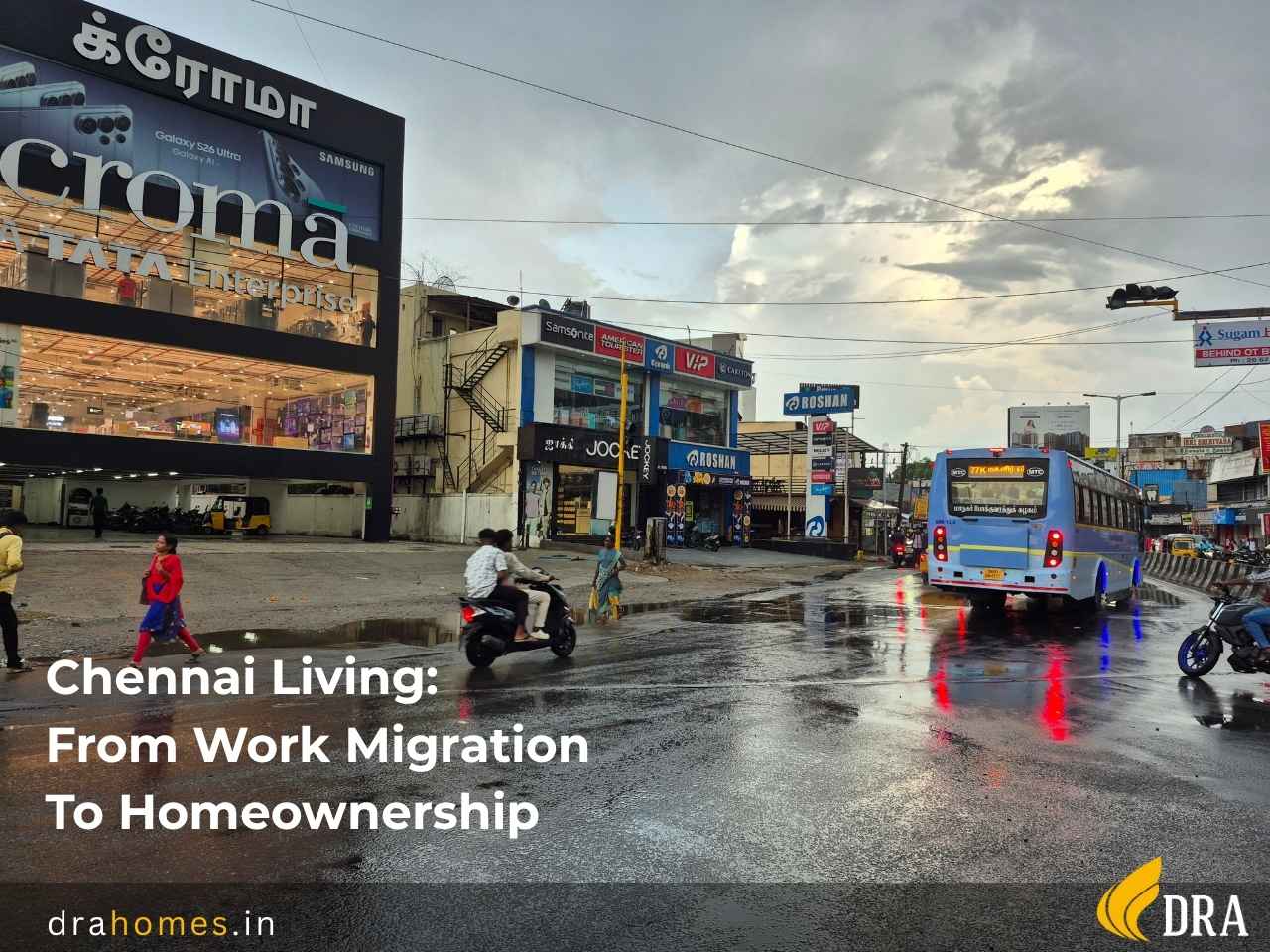
Busy Street Scene in Chennai Showing Commercial Hubs and Daily Commuters
Twenty-five years ago, accepting a job offer in Chennai usually meant packing a suitcase, not signing a property deed. Professionals arrived for work, stayed in rented rooms or company guest houses through the week, and treated the city as a temporary paycheck stop. The real home-the one that truly mattered-was always somewhere else.
That mindset has quietly dissolved.
While thousands of professionals still move to Chennai every year for career opportunities, what happens after they land has completely transformed. Instead of treating the city as a brief career posting, today’s workforce is laying down permanent roots. They aren't just commuting here for a job anymore-they are building their actual lives here, and that shift is marked by buying a home rather than renting one.
The old playbook was simple: you moved to Chennai because the job was here, and you packed up once the project ended or when you saved enough to build a home back in your native town.
In the early 2000s, Chennai’s economic engine ran predominantly on manufacturing, banking, and early-stage IT hubs concentrated in central pockets like Nungambakkam and Parrys. Living close to these employment hubs meant renting high-cost city-center apartments. Homeownership was viewed as a late-stage milestone-something accomplished near retirement after decades of
disciplined saving.
Today, the city attracts a larger and more diverse workforce than ever before. The core difference isn't whether people migrate here-it's what they intend to do once they arrive.
The real story lies in this underlying psychological shift. A generation ago, buying a house in Chennai was a distant reward earned after decades of career progression. Today, professionals in their late 20s and early 30s are taking out home loans years before their parents ever considered it.
This shift reflects a fundamental change in how residents view their tenure in the city:
Accelerated by structured real estate developments, accessible housing finance options, and a generation looking for urban stability, the transition from tenant to homeowner has accelerated significantly
across the region.
Because modern buyers are investing to settle down rather than renting to pass time, real estate growth has expanded beyond traditional city-center rental pockets. Instead, residential expansion is tracking key infrastructure and employment corridors.
Stretches along Old Mahabalipuram Road (OMR), including residential hubs like Navalur, have evolved into self-contained ecosystems. Families who once endured long commutes now live minutes from their workplaces in integrated communities built for
long-term living.
As manufacturing, industrial, and logistics networks expand westward, the western corridor offers plotted developments, gated communities, and spacious layouts for buyers seeking room to grow alongside
seamless connectivity.
Driven by infrastructure upgrades and expanding transit networks, Madhavaram of the northern corridor attracts early buyers who want to invest in developing residential hubs before prices hit peak maturity.
For home buyers prioritizing existing social infrastructure-proven schools, healthcare networks, and mature transit links—established suburbs like Valasaravakkam remain top picks for immediate settlement.
If you are weighing the decision between renting and buying a flat in Chennai today, market trends show that many professionals have already made the leap. The standard approach is no longer "wait and see"-it is "invest where you see yourself living long-term."
This shifts the dynamic of property search criteria:
Residential offerings across OMR, Poonamallee, Madhavaram, and Valasaravakkam are built specifically around this profile-designed not for transient renters, but for homeowners intent on putting down permanent roots.
Chennai is not a 'travel to work destination' anymore for professionals building a career. It has become the final destination to buy properties.
The most significant urban shift over the last quarter-century isn't just that people kept coming to Chennai for work-it is that they stopped leaving.


 Link Copied!