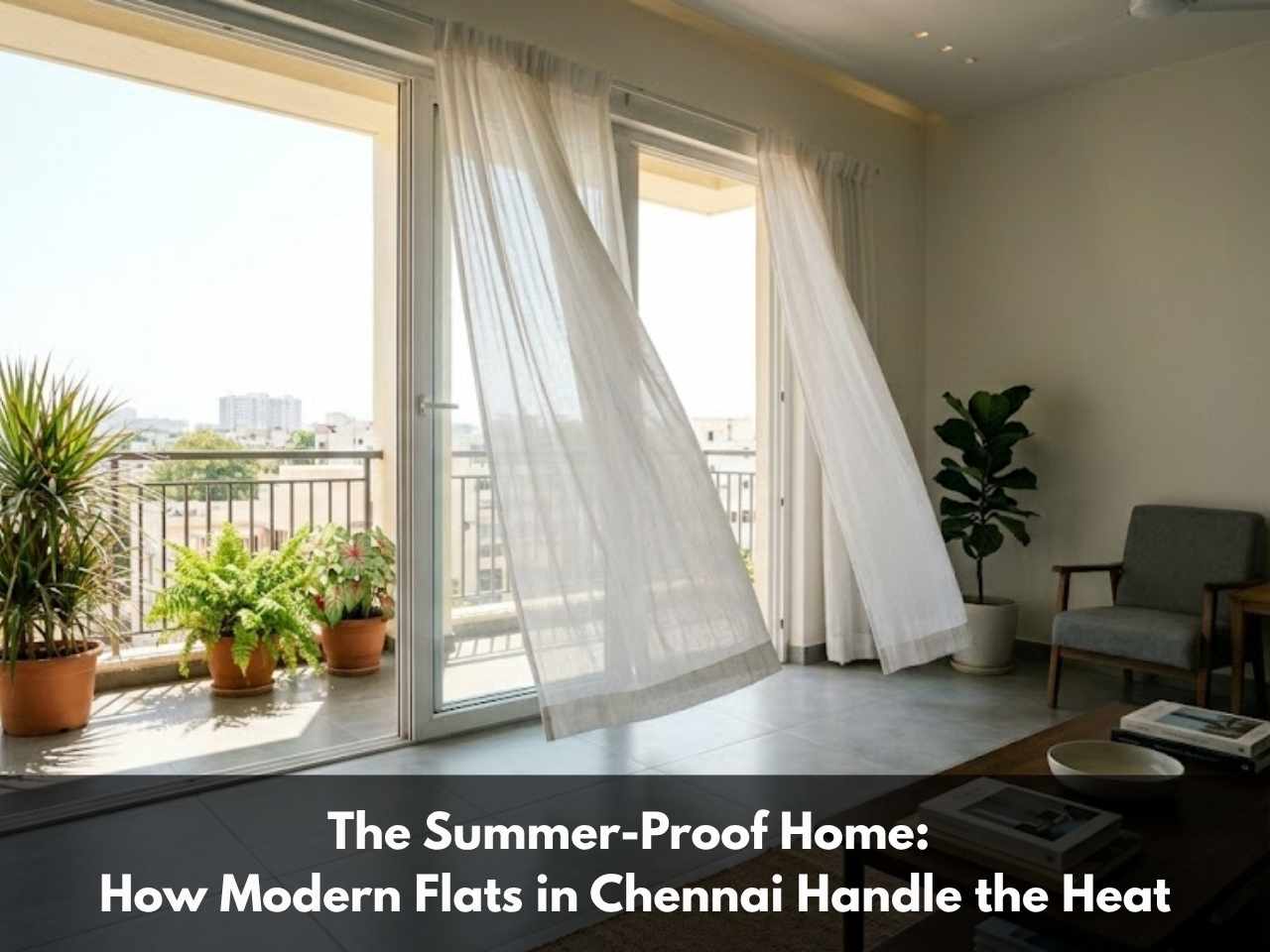
For most people buying flats in Chennai, the checklist looks something like this: location, price, floor plan, amenities. Heat management rarely makes the list.
But it probably should.
Chennai regularly crosses 40°C between March and June. Add the humidity, and a poorly ventilated flat can feel like a different city altogether. The AC runs longer, the electricity bill climbs, and the discomfort becomes part of daily life. In fact, weather is one of the most overlooked factors when buying a house in Chennai, and summer makes that very clear.
What many buyers don't realise is that this is largely a design problem. And design problems can be solved.
A flat that heats up quickly costs more to live in. Monthly electricity bills in Chennai during peak summer can range between Rs. 5,000 and Rs. 10,000 for a typical apartment, every month, for six months of the year.
That number adds up. And it does not include the faster wear on AC units, the interrupted sleep, or the general exhaustion of living in a home that works against the climate instead of with it.
This is why buyers exploring apartments in Chennai for sale are increasingly asking better questions, not just about square footage, but about how the home actually performs.
Good climate performance is not one feature. It is a series of decisions made at the planning stage. Once a building is complete, most of these cannot be changed.
Whether you are looking at a 2BHK flat in Chennai or a 3BHK flat in Chennai, these are the questions worth asking during your site visit. They are also the kind of details that experienced homebuyers look for within the first few minutes, while first-time buyers are still focused on the model flat finish.
One practical recommendation: Visit the project at 2 PM on a summer afternoon, not during an evening walkthrough. What you see in a model flat and what you experience in the actual unit can be quite different, knowing that gap before you sign is important. A flat that feels comfortable at that hour has been designed with the city's climate in mind.
A summer-proof home costs less to run, holds its value better, and is easier to sell when the time comes. That is not a bonus, it is the result of decisions made long before the building went up. And if long-term resale value matters to you, how a home handles six months of Chennai heat is one of the most important things to get right.
At DRA Homes, climate performance is built into every project from the planning stage, not added on as a finishing touch. Solar movement, wind direction, material suitability, these decisions happen at the blueprint level, because by the time a project is ready for possession, none of them can be revisited.
Because in Chennai, a good location and a fair price will only take you so far. How your home performs through six months of intense heat is what makes it a sound decision for the long term.
The right home does not just shelter you from the heat. It is designed to work within it.


 Link Copied!