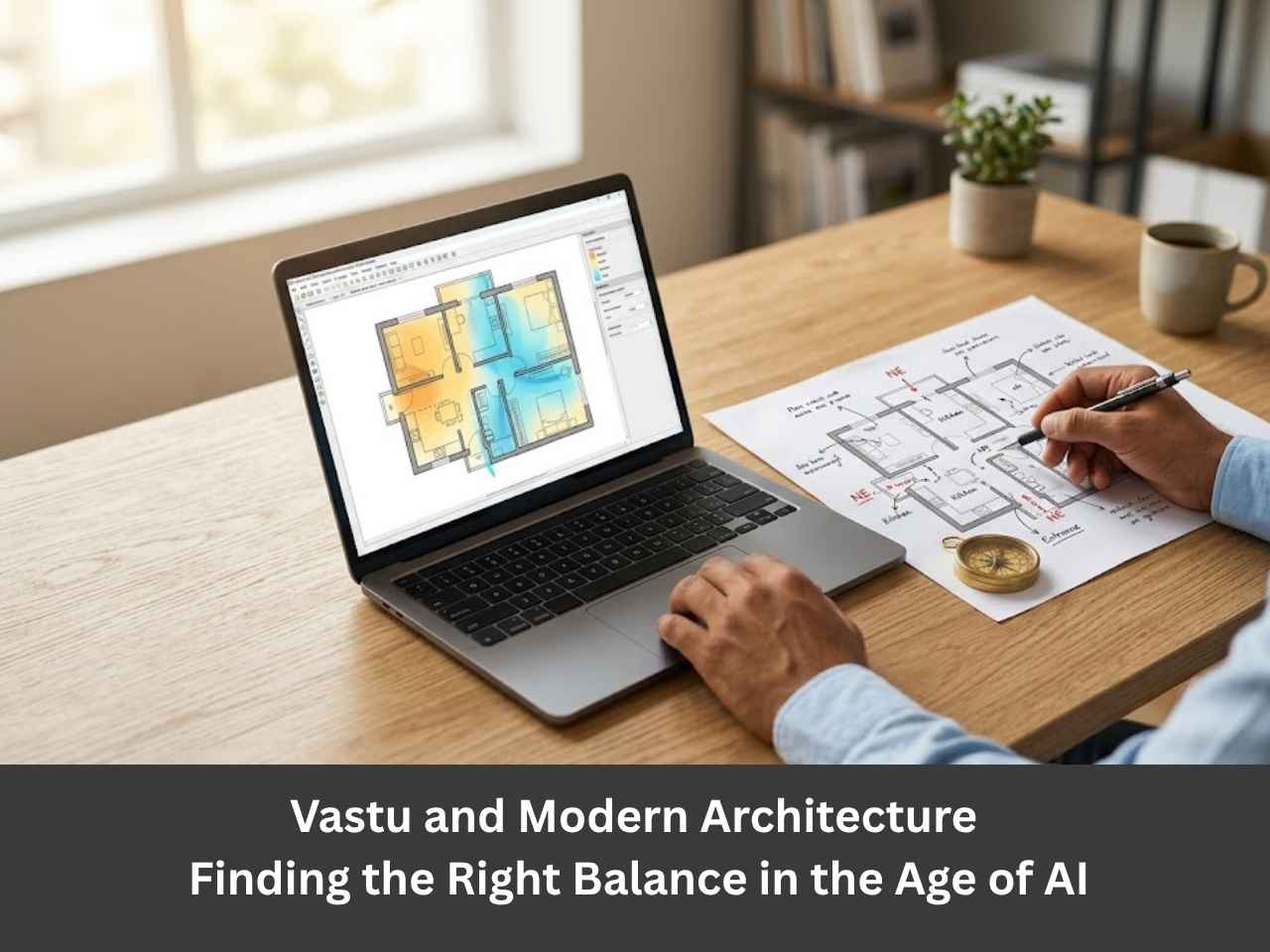
For years, the conversation around Vastu Shastra and home design has played out the same way: one side calls it tradition, the other calls it science, and buyers are left to pick a lane.
That conversation is worth revisiting, not because anyone has resolved the philosophical debate, but because architecture now has better tools to answer the question it has always cared about: does this design actually make a home healthier, more comfortable, and more functional to live in? AI lets architects test that question with precision, simulating daylight, airflow, heat, and movement through a space before construction
even begins.
What's interesting is what happens next. A floor plan optimised purely for comfort and performance often lands close to what a Vastu consultant would have recommended anyway. That's not because AI is validating Vastu. It's because both are responding to the same physical realities, where the sun falls, how air moves, where heat builds up, just through very different vocabularies and very different timelines.
This isn't another explainer on what Vastu is, or another AI trend piece. It's a look at where good architecture and Vastu principles genuinely overlap, where they don't, and what that actually means if you're evaluating an apartment in Chennai.
Walk through almost any apartment site visit in Chennai, and someone will ask which direction the main door faces before they ask about the amenities.
That's not superstition. It reflects how deeply Vastu is woven into Indian homebuying, across generations and income levels. A survey by 99acres found that 62% of Indian homebuyers prefer Vastu-compliant homes, and 44% are willing to pay a premium for one. A separate Anarock study puts the figure even higher, with nearly 80% of buyers treating Vastu compliance as a key factor in their decision.
Even buyers who don't personally follow every guideline often face pressure from family, parents and in-laws who are co-funding the purchase and carry strong preferences. There's a resale dimension too: apartments perceived as "non-Vastu" sometimes face more buyer hesitation years later, regardless of build quality.
Vastu matters to today's buyers because:
Developers in Chennai have quietly built Vastu-friendly principles into their planning for years, through orientation, room placement, and light access. What's new is that AI now gives architects a way to prove those decisions work, rather than simply asserting them.
Until recently, the only way to know if a floor plan delivered good light and airflow was to build it, live in it, and find out. Today, architects run digital simulations before a single wall goes up.
Daylight simulation software models how sunlight moves through a proposed floor plan across every hour and every season, showing exactly which rooms get harsh western heat and which get gentle morning light. This is the same principle behind Vastu's preference for north or east-facing entrances, except now it's rendered as a heatmap, not a guideline.
AI-based airflow and ventilation modeling simulates how air moves through a layout, identifying dead zones where humidity will collect and pathways where cross-ventilation actually works. In a coastal, humid city like Chennai, this matters as much for comfort as for the building's long-term structural health.
Generative floor-planning tools can produce dozens of layout variations that meet a given brief, then rank them by daylight access, ventilation efficiency, and privacy between zones. Some firms are now feeding Vastu constraints into these tools alongside functional ones, treating "kitchen in the southeast" the same way they'd treat "keep the bedroom away from the elevator shaft": as a design constraint to optimise around, not a rule to argue about.
AI-assisted Vastu compliance checks are also emerging as a category of their own, apps and plugins that scan a floor plan and flag deviations from traditional Vastu guidelines instantly, the same way a spell-checker flags a typo.
None of this makes Vastu "scientifically proven." What it does is let architects and buyers see, with actual data, where a traditional recommendation and a performance-optimised layout land in the same place, and where they don't.
Strip away the vocabulary, and several Vastu principles hold up well against what modern architecture has always cared about: light, air, heat, and how a home actually functions.
None of this means ancient builders understood fluid dynamics. It means they were solving real problems long before anyone had the tools to describe those solutions precisely, and today's tools are mostly just catching up to what good design already knew.
Modern architecture has always prioritised one simple question: does a design make a home healthier, more comfortable, and more functional for the people living in it? Today, AI helps architects answer that question with far greater accuracy, simulating daylight, ventilation, heat gain, energy efficiency, and movement through a space before construction even begins.
That doesn't mean architecture has started validating every aspect of Vastu. It simply means designers now have better tools to test the physical performance of a home. If a layout allows more natural light, better cross-ventilation, or improved thermal comfort, those benefits can be measured. If it claims to improve wealth, career success, or family harmony, those outcomes fall outside what architecture or engineering can verify.
This distinction matters because modern architects increasingly use AI to support evidence-based design, not to replace cultural preferences. Many Vastu principles align naturally with good architectural practice, which is why they often appear in well-designed homes. Others remain matters of personal belief rather than measurable building performance.
For homebuyers, the takeaway is straightforward. Choose a home that performs well in the ways architecture can prove: good light, effective ventilation, thoughtful planning, and quality construction. If Vastu principles are also important to your family, they can comfortably sit alongside those priorities, without being confused with scientifically measurable outcomes.
"AI can prove Vastu is
scientifically correct."
AI can measure whether a layout performs well, good light, effective airflow, lower heat gain. It can't verify claims about wealth, luck, or family harmony, because those were never architectural outcomes to begin with. Simulation tools test performance,
not belief.
"If architecture uses AI, Vastu doesn't matter anymore."
Not really. Many Vastu principles already align with good design, which is why they show up naturally in well-planned homes. AI hasn't replaced that overlap, it's just given architects a more precise way to build for it.
"Every east-facing home is
automatically better."
Direction alone doesn't determine quality. A poorly ventilated, badly constructed east-facing apartment is still poorly ventilated. Construction quality and layout affect daily life far more than orientation on its own.
"A non-Vastu apartment is a
bad investment."
Resale value is driven mainly by location, builder reputation, construction quality, and market conditions, not primarily by
compass orientation.
"Apartments can't follow Vastu."
They can follow what matters most architecturally, light, ventilation, functional layout. Full compliance written for standalone homes on open plots rarely applies to high-rises either way.
Whether or not a developer is using
AI-based design tools, here's a practical way to weigh your decision:
Prioritise first: builder credibility and RERA registration, construction quality including concrete grade and waterproofing, location fundamentals like commute and infrastructure, and layout quality, natural light, ventilation, room sizing, and privacy between zones.
Prioritise alongside: Vastu preferences that genuinely matter to your family, such as entrance direction or kitchen placement, and long-term maintenance factors like water supply reliability and common area upkeep.
Prioritise last, or not at all: astrology-based purchase timing, the exact compass degree of every room, and any claim that one specific apartment will bring fortune while another won't, AI-verified or otherwise.
Buyers who get the best outcomes tend to treat both Vastu and AI-modeled performance data as inputs, not verdicts. A home that delivers good light, good air, solid construction, and a credible developer will serve a family well for decades, regardless of which tool told you so.
Architecture has always aimed for the same outcome: a home that's comfortable, healthy, and functional to live in. AI hasn't changed that goal, it's just made it possible to test for it with real precision before a single wall goes up. Along the way, that precision keeps confirming what good design, and often Vastu, already understood about light, air, and space.
Where the two align, on daylight, airflow, heat, and layout, that's worth taking seriously. Where Vastu goes further, into promises no design system can measure, that's a matter of personal belief, not architectural performance.
If you're evaluating a home built on both sound design principles and genuine attention to detail, explore DRA Homes' current projects across Chennai. Good design stands up to both timeless architectural principles and modern performance testing. Ultimately, what matters most is how comfortably and confidently a home supports everyday life.
For more on how we think about the fundamentals behind a well-designed apartment, see our guide to what actually makes a home feel all-inclusive and livable, and if budgeting is your next step, our breakdown on planning your down payment for a Chennai apartment is a useful
next read.
Is Vastu still relevant now that AI can design homes?
Modern architecture already prioritises light, air, and layout, and AI simply helps test those more precisely. It doesn't replace the cultural and personal reasons families still value Vastu compliance
Can AI check if my apartment is
Vastu-compliant?
Yes, some tools and apps now scan floor plans against traditional Vastu guidelines. These checks confirm adherence to the rules, not any guarantee of outcomes like wealth or luck.
Does AI-based home design cost more?
Not typically for the buyer. Most AI simulation and generative design tools are used by architects and developers during planning, and the cost is absorbed into the overall project, not passed on as a
separate charge.
Which matters more when buying a flat: Vastu or AI-optimised design?
Neither should be the sole deciding factor. Construction quality, location, and layout affect daily life far more than either compass orientation or simulation
scores alone.
What should I prioritise over both Vastu and AI compliance scores?
Builder credibility, construction quality, and location fundamentals. A well-built home in a strong location will serve your family well regardless of its Vastu or
AI performance score.


 Link Copied!